
You’ve been thinking about installing putting greens for your home or business. But you’re stuck debating whether an indoor green or outdoor green would be better. Both options have their pros and cons. To help you figure out which is right for you, here’s what you need to know about indoor vs. outdoor putting greens.
Indoor Putting Green
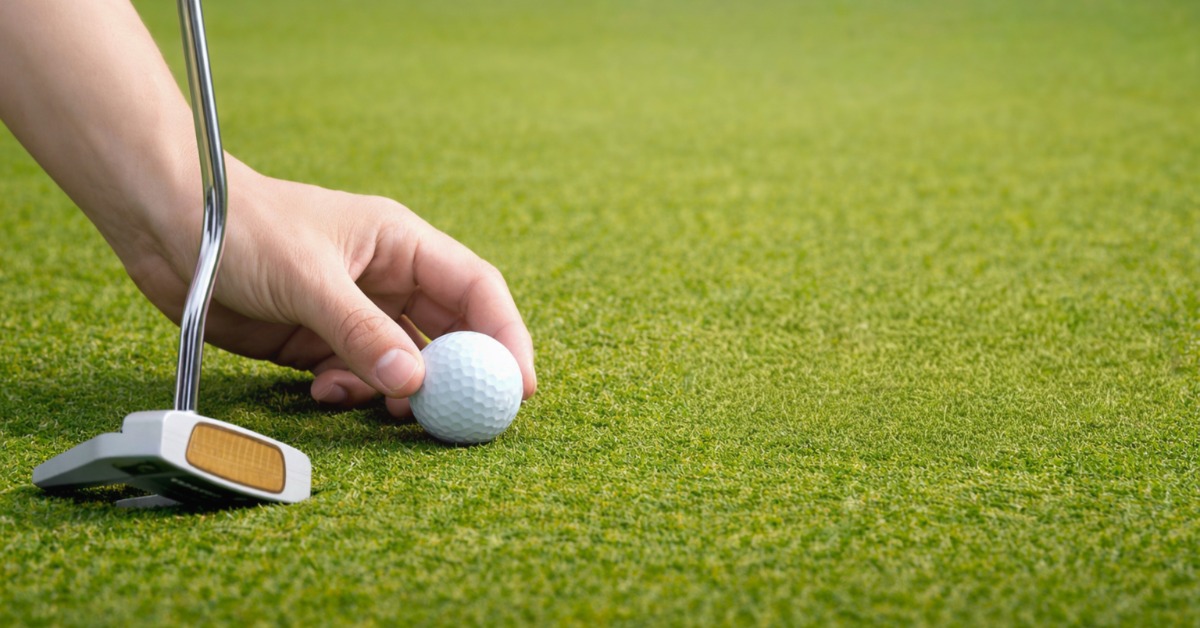 An indoor putting green is an artificial turf surface installed inside a building. That could be a spare bedroom, a finished basement, a commercial office, or a dedicated sports room. Because the turf goes inside, it’s engineered for low pile height and smooth roll, which keeps your ball tracking true across a flat or moderately contoured surface.
Indoor greens work well for:
- Homeowners who want to practice year-round without going outside
- Businesses that want an amenity space for clients or employees
- Golfers who need a controlled environment to work on stroke mechanics
- Properties in climates where outdoor use is limited by weather
Features of an Indoor Putting Green
The turf itself is only part of what makes an indoor green work. A few specific design elements determine how the surface performs and how well it fits into the space you’re installing it in.
Surface Pile Height
Indoor turf runs shorter than outdoor turf, which is one of the first things you’ll notice when you compare the two side by side. A lower pile creates a faster, more consistent roll, and that’s what you want when you’re focused on stroke repetition. If the pile is too tall, the ball drags and you lose the feedback you’re practicing for.
Subfloor Compatibility
Before you commit to an indoor installation, the subfloor underneath the turf needs to be level and firm. Concrete and hardwood both work well. Carpet underneath turf is a problem because the surface compresses unevenly, which throws off your putting line. A good installer will check the subfloor before anything goes down.
Hole and Cup Configurations
Indoor greens can be installed with one or multiple cup configurations depending on the room size and what you want to practice. A smaller room can hold a simple single-hole layout. A longer room opens up options for multiple targets or a straight-line distance drill setup.
Fringe and Edging
The border of an indoor green is usually finished with a fringe strip or a clean edge trim that meets the existing flooring. It protects the turf backing from lifting over time and gives the whole installation a finished look.
Outdoor Putting Green
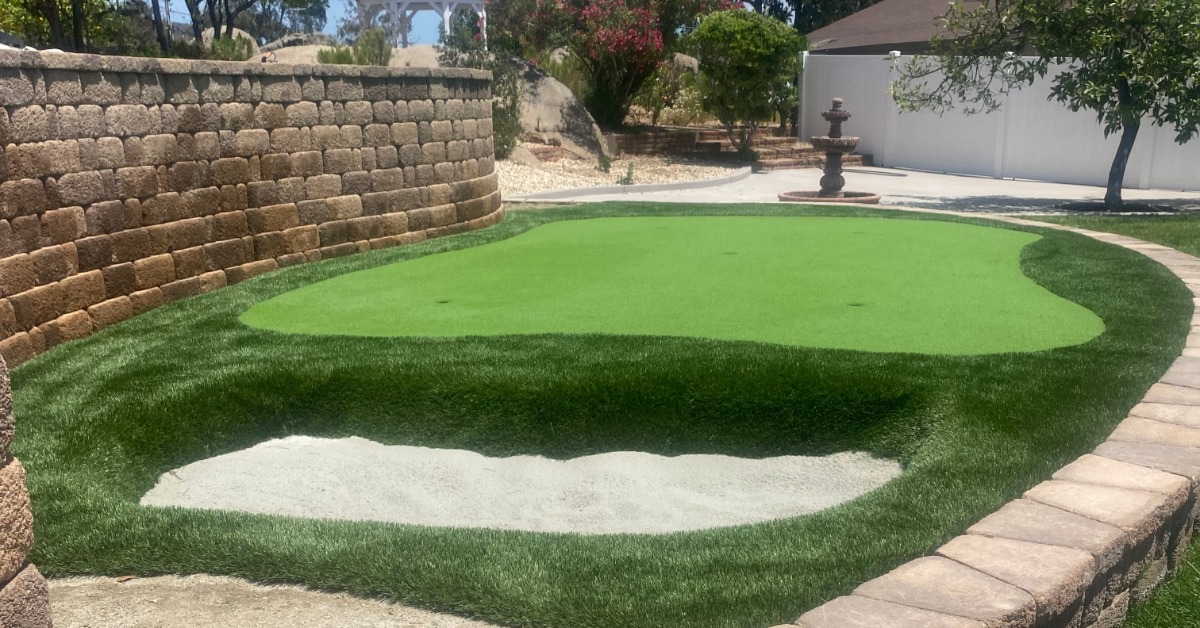
An outdoor putting green is an artificial turf surface installed in an exterior space, most commonly a backyard, a commercial property, or a landscaped area. Outdoor turf is built to handle sun exposure, foot traffic, drainage, and temperature shifts, all of which indoor turf doesn’t need to manage.
Outdoor greens work well for:
- Homeowners who want a backyard feature that works for both practice and entertainment
- Contractors building out custom landscapes with multiple use zones
- Commercial properties that want a visible outdoor amenity
- Golfers who want a more realistic putting experience with natural light and varied terrain
Features of an Outdoor Putting Green
The surface is just the starting point. What separates a well-built outdoor green from a mediocre one is everything that goes into and underneath it before the turf ever gets rolled out.
UV-Stabilized Turf
Outdoor turf is treated to resist UV degradation, which is what keeps the color from fading and the fibers from breaking down after years in direct sunlight. Without that treatment, the turf would gray out and get brittle within a few seasons. When you’re shopping outdoor turf, UV stabilization isn’t a bonus feature; it’s a baseline requirement.
Drainage System
An outdoor green needs a drainage layer underneath it to move water off the surface after rain. Without proper drainage, water pools, the base shifts, and the surface becomes uneven. A well-installed outdoor green drains at a rate that keeps the surface playable shortly after a heavy downpour.
Base Construction
The base of an outdoor putting green is built up from compacted aggregate, usually crushed rock, before the turf goes down. That base creates the firmness the turf needs to hold its contour and perform consistently. It also prevents the ground from settling unevenly over time, which would show up as dips and ridges across your putting line.
Contouring and Breaks
Outdoor installations have more room to work with, so you can incorporate slope, breaks, and multiple elevation changes into the design. That’s what makes an outdoor green feel closer to an actual golf course. If you’re practicing for real-course play, a contoured outdoor green gives you more useful repetitions than a flat indoor surface.
How to Know Which One You Need
This is where the decision gets personal. Before you plan out materials or call a contractor, run through these questions honestly:
- Do you have an outdoor space that gets enough sun and drainage to support a green, or is your yard shaded, sloped, or too small to work with?
- Are you practicing for improvement, or do you want a space that also works for entertaining guests?
- What’s your climate like? If rain, heat, or cold limits your outdoor time for several months a year, an indoor green gets more use.
- Is the installation going into a commercial space where clients or employees will see it? That changes how the finished look needs to read in the room.
- What kind of putting experience do you want? A flat, fast surface for stroke mechanics points toward indoor. A contoured, multi-hole layout for variety points toward outdoor.
- Who’s using it? A single golfer working on a specific weakness has different needs than a household or business where multiple people will use the green casually.
There’s no wrong answer between the two. Both deliver a practice surface that holds up over time. The difference is in how you use the space, how much of it you have, and what kind of experience you’re after.
The Setup That Actually Gets Used
Is an indoor or outdoor putting green right for you? That comes down to factors like how you plan to use the space and how much room you’re working with. Consider your climate, your goals, and who’ll be using the green carefully before planning out your project.
Once you decide what fits your situation, JUS Turf has artificial putting greens in San Diego for sale. Visit our local warehouse with your measurements and we’ll help you select the right turf for your installation. In-stock options are available for take-home same day, so there’s no delay in getting your project started.